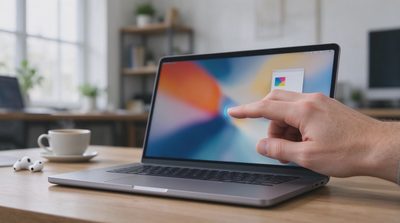
Rumors about an OLED MacBook Pro have circulated for years. In October 2026 the volume and consistency of reports have increased sharply, with multiple outlets pointing to a possible announcement around October 28. The claims center on the first OLED panel in a MacBook, a touchscreen, a lighter chassis, and continued use of the current M5 Pro and M5 Max chips. I treat every one of these points as unverified until Apple shows the hardware. Here is a careful separation of what repeated reporting currently suggests and what is still open or speculative.
The Core Claims Circulating Right Now
The strongest and most consistent reports describe 14-inch and 16-inch MacBook Pro models that replace the current mini-LED Liquid Retina XDR panels with OLED. OLED would bring perfect blacks, higher contrast, and potentially better power efficiency in dark content. The same reports link the OLED panel to a touchscreen layer. Apple is said to be treating touch as a supplementary input method that works alongside the keyboard and trackpad rather than replacing them.
A reinforced hinge is frequently mentioned so the display does not flex or bounce when tapped. Design changes are described as making the machines noticeably lighter, though exact weight reductions remain unknown. Some reports also mention a Dynamic Island-style camera housing that would replace the current notch. All of these details come from secondary reporting; none have been confirmed by Apple. The consistency across several independent sources raises confidence that Apple is at least testing such a configuration, but testing is not the same as shipping.
Timing and Launch Expectations
Multiple sources now converge on a late-October introduction, with an in-person media event in Los Angeles described as a “Pro and Tell” gathering rather than a traditional livestreamed keynote. Some reports suggest store resets around November 5–6 that could precede retail availability. These dates are still estimates based on supply-chain and retail signals. Apple has not announced any event or product.
Historically Apple has delayed or altered products when yields, component costs, or software readiness were not ready. An OLED touchscreen MacBook would be a significant manufacturing and software change, so schedule slips remain possible even at this late stage. Component availability for large OLED panels has been a recurring constraint in the industry; any last-minute yield issues could push the machines into early 2027.
Chips and Performance Expectations
Current reporting indicates the new models would use the existing M5 Pro and M5 Max chips rather than a new M6 generation. That would mean the performance ceiling stays roughly the same as today’s high-end MacBook Pros, while the display and input methods change. Earlier rumors had suggested M6 Pro and M6 Max silicon; more recent accounts have walked that back. Until Apple publishes specifications, chip identity remains a rumor.
If the machines ship with current M5-series silicon, buyers would be paying primarily for the OLED panel, touch capability, and any industrial-design refinements rather than a generational leap in CPU or GPU performance. For professionals who already own an M5 Pro or Max machine, the upgrade case would rest almost entirely on the display and touch features.
What OLED Would Actually Change
An OLED panel would improve contrast and black levels dramatically compared with the current mini-LED displays. HDR content, dark-themed interfaces, and video editing in dim environments would look more precise. Power draw can be lower when large areas of the screen are black, which could help battery life in some workflows. Brightness, longevity, and potential burn-in risk are the open questions that only real hardware can answer.
Apple has years of experience with OLED on iPhone, Apple Watch, and iPad Pro. Scaling that technology to a 14- or 16-inch laptop while meeting Mac brightness, color accuracy, and durability standards is a non-trivial engineering task. Reports of higher pricing reflect the expected cost of the panel and the touch layer. Color volume, peak brightness in sustained use, and how the panel handles prolonged static UI elements will determine whether the upgrade feels transformative or merely incremental for professional color work.
Touch as a Supplementary Input
The consistent framing in recent reports is that touch would be optional and secondary. Users could ignore it entirely and continue working with keyboard and trackpad. macOS 27 has already shown interface adjustments—larger hit targets, refined gestures, and better finger-friendly controls—that look like preparation for touch. A reinforced hinge would address the practical problem of a laptop screen that moves when pressed.
Whether the software experience feels natural after years of trackpad-centric design is something only hands-on use can determine. Early adopters would be testing both the hardware and Apple’s first serious attempt at touch on the Mac. The risk is that half-implemented touch support creates more friction than it removes; the opportunity is a genuinely useful secondary input for creative and annotation tasks.

Price and Product Line Questions
No official pricing exists. Analyst and media estimates have suggested a premium of roughly 15–20 percent over current MacBook Pro models, which would push starting prices higher than today’s M5 Pro configurations. Some reports raise the possibility that the OLED touchscreen models would sit above the existing mini-LED MacBook Pros rather than fully replacing them, at least for a generation. That approach would let Apple keep a lower price floor while offering the new display technology as a higher-tier option.
Until Apple publishes a price list, any dollar figure is speculation. Buyers should also watch for differences in base memory and storage configurations; a higher starting price paired with the same base specs as today’s models would reduce the value proposition.
What Remains Firmly in the “Do Not Know” Category
Exact weight and thickness numbers are unknown. Battery-life impact of the OLED panel plus touch layer is unknown. Whether the touch implementation supports Apple Pencil or only finger input is unconfirmed. Final chip configurations, memory options, port layout, and camera details are still rumor. The product name itself has fluctuated between MacBook Pro and occasional “Ultra” speculation; recent reporting has settled back on Pro.
Any claim that the machine will definitively launch on a specific date, at a specific price, or with a specific set of features should be treated as provisional. Supply-chain constraints, software polish, or last-minute design changes could still alter the final product.
Practical Advice for Buyers Right Now
If you need a MacBook Pro today for work, the current M5 models remain excellent and are fully supported. Waiting for an unannounced product always carries the risk of delay or disappointment. If your current machine is adequate, there is no reason to pause purchases solely because of these rumors. If you are specifically waiting for OLED or touch and can tolerate uncertainty, the next few weeks should clarify whether the reports materialize.
I will update this assessment the moment Apple shows actual hardware. Until then, treat every detail above as informed rumor rather than fact. The safest posture is to assume nothing is certain until the product is on a stage or a store shelf.